
Binding through a full day is one of the most common real-world challenges for trans and nonbinary people — and one of the least covered. Most binding guides address safety in general terms. This one is different.
Whether you're a student navigating a school uniform, an employee in a physical job, or someone simply trying to make it through an eight-hour day comfortably, the specific pressures of structured environments matter: the long hours, the limited privacy, the heat of an Australian summer, and the lack of flexibility to take breaks when you need them.
This guide is Australia-specific throughout. The climate, the school policy landscape, and the workplace legislation all shape the experience of binding here — and generic overseas guides often don't reflect that.
The average school or work day runs between seven and nine hours. That puts it at or near the upper end of the recommended 8–10 hour daily binding limit — which means preparation and binder choice matter more, not less.
This isn't a reason to avoid binding through the day. It is a reason to be thoughtful about which binder you choose, how you structure your routine around it, and what you do before and after.
For a full breakdown of wear time recommendations, read our How Long Can You Wear a Chest Binder guide.
Not all binders are equally suited to extended wear. The right choice depends on your body, your day, and what you need from your binder during it.
Adjustable Crop Binder — The ability to loosen compression while wearing it makes this a practical option for long days. If you know you’ll need to ease off mid-afternoon, the Adjustable Crop gives you that flexibility without removing the binder entirely.
Sensory Compression Vest — Our most accessible style and the best choice for all-day comfort. The straight cut means no tapering at the ribs, which significantly reduces pressure during long wear. Ideal for desk-based work, long school days, and anyone with sensory sensitivities or health conditions.
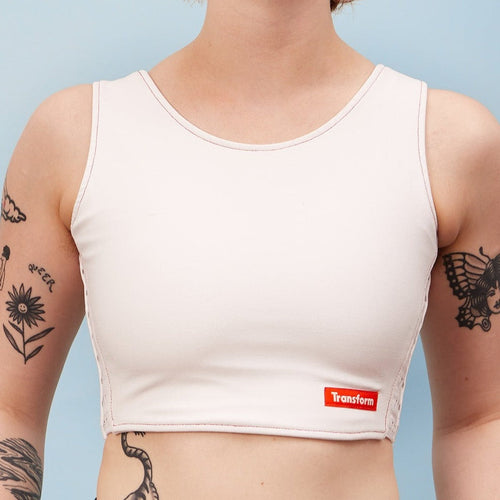
Tank Binder — A strong option for longer torso coverage and larger chests. The extended length distributes compression more evenly across a greater surface area, which many wearers find more comfortable over a full day.
Limited Edition Crop — Well suited to active school days that include PE, sport or movement-heavy work. The contoured fit stays in place during physical activity, and the design itself promotes freedom of movement.
The key principle: match your binder to your day, not just your body. A binder that works well for a Saturday afternoon may not be the right choice for a nine-hour work day in January.
For a full breakdown of every style in our range, read the Transform Transwear Chest Binder Comparison Guide.
Australian summers make long-wear binding significantly harder. Heat increases sweating, skin irritation and general discomfort under compression — and in a school or workplace where you can’t always step outside or adjust your clothing freely, the effects compound quickly.
A few practical strategies:
For full safe binding guidelines, visit our Chest Binder Safety Guide.
A consistent daily routine makes long-wear binding more manageable and reduces the risk of pushing past comfortable limits.
School uniforms create specific challenges for trans and nonbinary students, particularly where dress codes are gendered. A few things worth knowing:
On the practical side, wearing a binder under a school uniform:
In most workplaces, you will never need to disclose that you wear a chest binder. It’s a garment, not a medical device, and it’s not your employer’s business unless you choose to make it so.
Situations where a conversation might arise include physical jobs with specific PPE or safety gear requirements, workplaces with mandatory uniform or dress code checks, or roles that involve occupational health assessments.
If you do need to navigate a workplace conversation:
Australian workplace protections are worth knowing. Gender identity is a protected attribute under the Sex Discrimination Act 1984 (Cth), which means discrimination or harassment on the basis of gender identity is unlawful in employment. State and Territory legislation provides additional protections in some jurisdictions.
The Australian Human Rights Commission has further information on your rights under federal law.
Needing to remove your binder during a school or work day is not a failure — it’s part of binding safely. Planning for this possibility in advance makes it a practical option rather than a stressful one.
You don’t have to navigate this alone. The following organisations offer support for trans and nonbinary people across Australia:
Binding at school or work is absolutely possible. With the right binder, a consistent routine, and a bit of preparation for the specific demands of your environment, it’s something thousands of Australians do comfortably every day.
The most important thing is choosing a binder that works for your body and your day — not just the flattest result in the abstract, but the most comfortable, practical and safe option for the hours you’re actually wearing it.
Browse the full Transform Transwear binder range, read our Chest Binder Comparison Guide to find the right style for your needs, or book a free fitting appointment in Melbourne if you’d like help in person.