

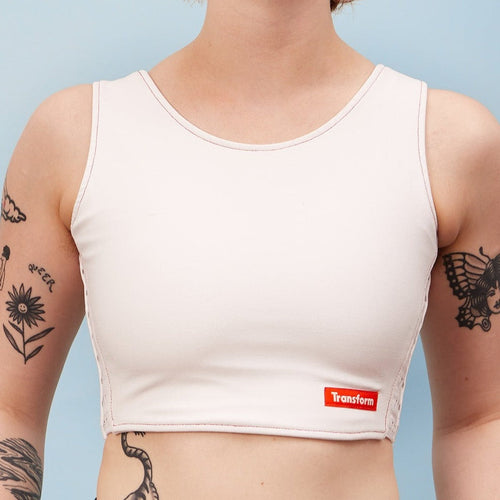







Chest binding is an essential gender-affirming practice for many trans and nonbinary people. But one question comes up again and again:
“Is it safe to exercise while binding?”
Until now, the honest answer was… we weren’t sure. Despite strong community advice not to exercise in a binder, there hasn’t been real scientific research to confirm whether binding actually affects physical performance.
That’s why this new study from the Mental Health & Exercise Research Group (MHEX), in collaboration with researchers from the University of Western Australia, Curtin University, UNSW Sydney, and Thriving in Motion, is such a big deal.
For the first time, researchers examined how wearing a chest binder impacts lung function, strength, and aerobic performance during maximal exercise — and their findings are reassuring.
What the Study Did
21 trans and nonbinary participants (average age ~30) completed two exercise sessions:
-
One session wearing a sports bra or similar
-
One session wearing their usual chest binder
Researchers measured:
-
Lung function (FEV6)
-
Upper-body strength (bench press one-rep max)
-
Aerobic fitness (VO₂ max)
-
Participants’ personal perceptions — comfort, breathing, effort levels, etc.
The assessments were done using standard sports science protocols to ensure the results were valid.
The Results: Minimal Impact on Physical Performance
Here’s the key takeaway:
Wearing a chest binder did not significantly affect lung function, strength, or aerobic performance.
More specifically:
-
Lung function differences were tiny and not statistically significant.
-
Strength (bench press) showed no meaningful change.
-
Aerobic capacity (VO₂ max) was also unaffected.
-
Shortness of breath and discomfort ratings remained similar across both conditions.
In short:
Participants performed just as well in their binder as they did without it.
Why This Matters
This research challenges a long-held belief that exercising in a binder is automatically unsafe or harmful.
Many community members avoid physical activity because they worry about:
-
Not being able to breathe properly
-
Overheating
-
Damaging their ribs
-
Being unable to move comfortably
-
Not being allowed to bind in gyms or sports environments
The study doesn’t claim binding is risk-free in every situation — and it doesn’t address long-term impacts — but it does show that, during short bouts of maximal exercise, chest binding did not reduce performance.
This matters because:
- It empowers trans and nonbinary people to participate in exercise without fear
- It gives clinicians and fitness professionals evidence-based guidance
- It challenges stigma around gender-affirming care
- It supports inclusive policies in sport and fitness spaces
A Note on Safety and Real-World Use
The researchers point out:
-
This study focused on acute (short-term) exercise, not long-term binding during sport.
-
Pre-existing pain, injuries, or chronic binder use weren’t assessed.
-
Participants used their own binder, ensuring the data reflects real lived experience.
As always, listening to your body matters. Everyone’s experience with binding is different.
Some general tips:
-
Choose a binder that fits properly
-
Avoid exercising in a binder if you experience pain, dizziness, or shortness of breath
-
Try moisture-wicking layers if overheating is an issue
-
Take rest breaks when needed
If you want to move your body, you deserve to feel safe and supported doing so.
What This Means for the Future
This research is a step forward — and the authors emphasise that more studies are needed on:
-
Long-term effects
-
Different binder styles
-
Different sports
-
People of different body types
But this is the first scientific evidence we have that working out in a binder may not reduce physical performance as much as many assumed.
That’s huge.
Final Thoughts
Chest binding is meaningful, empowering, and life-changing for many. Exercise is important for physical and mental wellbeing — and finally, we have evidence to reassure people who want to stay active while affirming their gender.
This study opens doors.
It pushes back against misinformation.
And most importantly, it supports trans and nonbinary people in living active, confident, affirmed lives.


